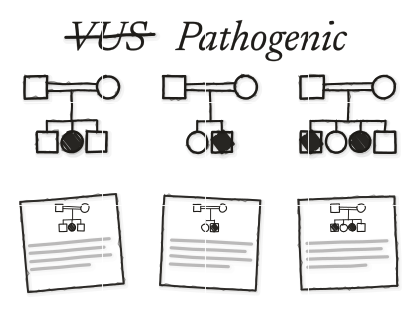
Every year, clinical geneticists across the Arab world publish case reports, cohort studies, and sequencing papers describing patients with rare genetic disorders. Multiple familial cases are reported, each often large and consanguineous. The variants are frequently homozygous, confirmed de novo, or segregating across multiple affected siblings in the same pedigree. The phenotypes are documented, and segregation evidence highlighted. This information is a gold mine in the field of clinical genetics.
These papers then land in PubMed, waiting for other clinicians to incorporate its data in the diagnostic odyssey of their own patients. It is often the case that the same variants described in these publications would be reported with "uncertain significance" with no supplemental data in every major clinical and variant database that clinicians utilize. A failure to translate data that already exists into the structured, computable form that variant classification systems require must be addressed.
The Specific Problem
The American College of Medical Genetics and Genomics / Association for Molecular Pathology (ACMG/AMP) 2015 variant classification framework, the standard used by clinical genetics labs worldwide, assigns pathogenicity scores based on a combination of population frequency, computational predictions, functional evidence, and, most critically, patient-specific evidence: de novo status, segregation data, phenotype match, and prior observations across independent families1. The framework is designed to accumulate evidence. A variant called a Variant of Uncertain Significance (VUS; a finding whose link to disease cannot yet be confirmed or excluded) today can reach "Likely Pathogenic" or "Pathogenic" once three independent families show segregation, or once a de novo event is confirmed in a patient with a matching phenotype.
A major bottleneck is that much of the evidence in the last five decades lives in the unstructured text of published papers. The scale of the problem is documented: AlAbdi and colleagues (2025) analyzed 2,908 medically relevant founder variants from over 18,000 Arab genomes and found that approximately 34% are entirely absent from gnomAD (the Genome Aggregation Database, the largest publicly available repository of human genetic variation)3, despite reaching local frequencies of up to 0.014. These same variants have, in many cases, been described in published literature, with segregation data, zygosity information, and phenotypic descriptions, but that information never made it into ClinVar or the Human Gene Mutation Database (HGMD; a comprehensive catalogue of inherited disease-causing mutations)5 in a form that affects automated classification. Separately, Ramaswamy et al. (2022) identified 39 variants with minor allele frequency greater than 1% in their Middle Eastern cohort that were listed as rare disease variants in ClinVar and HGMD, variants that, in a properly annotated population-matched database, should trigger a benign frequency criterion under the ACMG framework, applied when a variant is too common in the general population to plausibly cause a rare disease6. They were not triggering it, because the frequency data was missing from the reference databases clinicians use.
The most sustained attempt to address this gap was the Catalogue for Transmission Genetics in Arabs (CTGA), a manually curated bibliographic database7. As a former curator of CTGA, I can describe both what it achieved and where it broke. My colleagues and I demonstrated its value: of 1,365 variants reported in Emiratis and hosted in CTGA, 235 were entirely absent from ClinVar as of December 2022. A further 307 CTGA-classified pathogenic or likely pathogenic variants were classified as benign, VUS, or simply absent in ClinVar8. The curation process, reading papers, extracting fields by hand, and entering records one at a time, was arduous. CTGA has since been discontinued, and its data transferred to the genomics program at another institute. What it leaves behind is proof of concept and an honest account of manual curation's limits.
The Arab world generates an extraordinary natural experiment for rare disease genetics. Consanguineous marriage rates ranging from 20% to over 50% across the region produce autozygosity (a state in which both copies of a gene region are inherited from a common ancestor, markedly increasing the probability that recessive disease variants are present in their active, disease-causing form) at a scale unmatched in most other populations9. The result is a concentration of autosomal recessive homozygotes that would take decades of outbred population screening to produce elsewhere. A single extended could provide segregation evidence that would flag multiple ACMG criteria. This evidence is published at large but is relatively inaccessible, especially in a comprehensive sense, to the variant classification scoring engines that clinicians utilize.
What Is Technically Hard
The obvious move is to extract structured clinical evidence from published papers using large language models (LLM) and use it to populate a variant classification database. This is technically non-trivial in several ways that distinguish it from a standard Natural Language Processing pipeline.
The first challenge is field-level extraction accuracy. ACMG criteria require specific, typed data: zygosity (homozygous, heterozygous, compound heterozygous), inheritance mode, family structure (number of affected vs. unaffected, relationship), Human Phenotype Ontology (HPO; a standardised vocabulary of clinical abnormalities used to precisely describe patient symptoms in a machine-readable format10) codes, Online Mendelian Inheritance in Man (OMIM; a comprehensive catalogue of human genes and the genetic disorders they are associated with) disease codes11, de novo confirmation status, functional study type and result, and the variant in HGVS (Human Genome Variation Society) notation on a canonical transcript12. Clinical papers write in natural language, use non-standard terminology, describe family structures in prose, reference phenotypes without HPO terms, and report HGVS notation inconsistently. The extraction task is not summarization, but structured slot-filling against a schema with clinical semantics, where a missing value is not the same as an absent value, and where a wrong value (e.g., extracting heterozygous when the patient was compound heterozygous) can change a classification from Pathogenic to VUS.
The second challenge is provenance and independence verification. That the published pathogenic variant comes from a reputable source, and segregation with disease in affected family members is confirmed1. Due to multiple papers reporting on the same variant, patient, or patient family, an extraction pipeline must track whether a given variant observation is novel or a re-report of a previously extracted family, because counting redundant observations as independent evidence is a systematic error that would propagate through every downstream classification. ClinVar reports the submitter institution or lab via its API (Application Programming Interface; a structured channel through which software systems exchange data)2, enabling redundancy detection by cross-checking author-institution alongside patient and family IDs mentioned in various publications.
The third challenge is HPO normalization and phenotype-genotype matching. Papers describe clinical features in heterogeneous terminology, e.g. terms like "developmental delay”, "intellectual disability", and "cognitive impairment" may all refer to overlapping but not identical phenotypes. Mapping these to HPO IDs requires ontology-aware NLP, not simple string matching10. This matters for phenotype specificity; the criterion applied in scoring when a patient's clinical presentation is highly specific for the disease caused by the variant in question1).
How to Start
The initial phase of this work I have already built locally and which runs without cost; a functional ACMG scoring tool exists that takes structured patient context: universalized variant names and IDs, zygosity, inheritance, segregation data, de novo status, HPO terms, and OMIM IDs, with overlayed population-level annotations from gnomAD3, computational predictions from GeneBe (an automated variant annotation engine that applies sequence-level ACMG criteria15), as well as clinical significance from ClinVar2. The addition of country-specific reference genomes, data of which is now feasible to retrieve in countries like the UAE, Qatar, and Egypt, where various phases of their genome projects have been completed would be critical to the process. This would produce a defensible ACMG classification with criterion-level transparency and the tool would handle the patient context overlay which no existing annotation aggregator comprehensively provides.
The next phase is the LLM extraction pipeline, and the initial design work needs to be done carefully. The architecture that makes sense is not a single end-to-end extraction model but a staged pipeline: first, a paper-level relevance classifier (is this paper reporting original clinical observations, or is it a review, a method paper, a meta-analysis?); second, a variant-level entity extractor that identifies all HGVS strings, gene names, and associated phenotype terms; third, a family-level structured extractor that fills the ACMG context schema for each variant observation; and fourth, a confidence-scoring layer that flags low-confidence extractions for human review rather than silently passing them into the database.
The validation strategy does not require a pre-existing curated corpus. A set of ~50 papers can be selected from the Arab genetics literature and manually annotated by a clinical geneticist to ground-truth extraction quality; a one-time investment that creates a benchmark for the pipeline. As extraction fidelity improves, the fraction of outputs requiring human review decreases, and the pipeline moves progressively toward autonomous operation: ingesting new publications on a scheduled basis, resolving variants to canonical coordinates, populating the ACMG context schema, and flagging edge cases for spot-check rather than full curation.
A small team to build this: someone who understands the ACMG framework and clinical genetics well enough to design the extraction schema and validate outputs, and one person who can build and evaluate the LLM pipeline. The first deliverable: a validated extraction pipeline producing structured ACMG-ready evidence records from Arab genetics papers, linked to the existing annotation and scoring infrastructure, is achievable in a few months of focused work. The concept can then be extended to absorb data from publications across the world.
The published data from the last half century is structured enough to extract and large enough to change the classification of thousands of variants in active clinical use. The bottleneck to address here is not more sequencing, more patients, or more papers. It is a pipeline that reads what has already been written and turns it into a resource that clinicians can easily access.
References
- Richards S, Aziz N, Bale S, et al. Standards and guidelines for the interpretation of sequence variants: a joint consensus recommendation of the American College of Medical Genetics and Genomics and the Association for Molecular Pathology. Genetics in Medicine. 2015;17(5):405–423.↩↩↩
- Landrum MJ, Lee JM, Benson M, et al. ClinVar: public archive of interpretations of clinically relevant variants. Nucleic Acids Research. 2016;44(D1):D862–D868.↩↩
- Karczewski KJ, Francioli LC, Tiao G, et al. The mutational constraint spectrum quantified from variation in 141,456 humans. Nature. 2020;581:434–443.↩↩
- AlAbdi L, Maddirevula S, Aljamal B, et al. Arab founder variants: contributions to clinical genomics and precision medicine. Med. 2025;6(3):100528.↩
- Stenson PD, Mort M, Ball EV, et al. The Human Gene Mutation Database (HGMD®): optimizing its use in a clinical diagnostic or research setting. Human Genetics. 2020;139:1197–1207.↩
- Ramaswamy S, Jain R, El Naofal M, Halabi N, Yaslam S, Taylor A, Abou Tayoun A. Middle Eastern genetic variation improves clinical annotation of the human genome. Journal of Personalized Medicine. 2022;12(3):423.↩
- Centre for Arab Genomic Studies. Catalogue for Transmission Genetics in Arabs (CTGA). cags.org.ae/ctga. (Database discontinued; archived, and delivered as a reference to the Dubai Health Genomic Medicine Center)↩
- Bizzari S, Nair P, Hana S, Deepthi A, Al-Ali MT, Al-Gazali L, El-Hayek S. Spectrum of genetic disorders and gene variants in the United Arab Emirates. Frontiers in Genetics. 2023;14:1177204.↩
- Alkuraya FS. Autozygome decoded. Genetics in Medicine. 2010;12(12):765–771.↩
- Köhler S, Gargano M, Matentzoglu N, et al. The Human Phenotype Ontology in 2021. Nucleic Acids Research. 2021;49(D1):D1207–D1217.↩↩
- McKusick VA. Mendelian Inheritance in Man and its online version, OMIM. American Journal of Human Genetics. 2007;80(4):588–604.↩
- den Dunnen JT, Dalgleish R, Maglott DR, et al. HGVS recommendations for the description of sequence variants: 2016 update. Human Mutation. 2016;37(6):564–569.↩
- Freeman PJ, Hart RK, Gretton LJ, Brookes AJ, Dalgleish R. VariantValidator: accurate validation, mapping, and formatting of sequence variation descriptions. Human Mutation. 2018;39(1):61–68.
- Genome Reference Consortium. GRCh38: Genome Reference Consortium Human Build 38. ncbi.nlm.nih.gov/grc/human.
- GeneBe variant annotation platform. genebe.net.↩