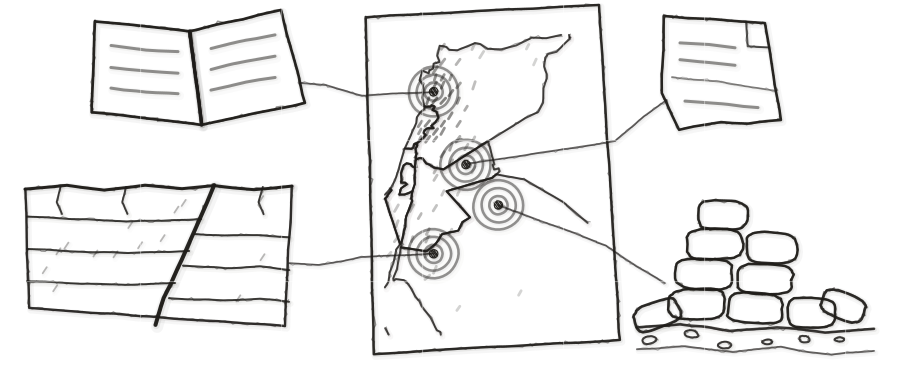
A measurement problem dressed as a tectonic one
The most useful artifact a CS undergraduate can hand to Dead Sea Transform (DST) seismology in 2026 is not a longer list of earthquakes; it is a quantitative model of which earthquakes the Arabic chronicles would have failed to record. A twelfth-century Damascene compiler such as Ibn al-Qalānisī over-witnesses tremors in the cities his informants and patrons inhabited (Damascus, Cairo, and to a lesser extent Aleppo), and underwitnesses anything that shook only Transjordan, the ʿArabah, or the northern Ḥijāz. The southern DST segments where Engelberg, Wetzler, and Agnon (2025, SRL, DOI 10.1785/0220240414) map seismic gaps, and where Lefèvre et al. (2018) and Klinger and colleagues leave the longest open paleoseismic windows, are exactly the segments such a chronicler would have been deafest to. A catalog “gap” can mean real strain accumulation, or it can be an artifact of where literate Muslims lived and whom they cited; existing catalogs do not separate the two, and that separation is what this proposal builds.
Why this matters now
On 6 February 2023, two ruptures on the East Anatolian Fault Zone killed more than sixty thousand people in southern Türkiye and northern Syria. The Kahramanmaraş sequence sat on a fault that flows, through the Maraş triple junction, into the northern Dead Sea Transform; Meghraoui et al. (2025, Tectonophysics) modeled Coulomb stress transfer from those ruptures into the northern DSF. About fifty million people live along the DST corridor through Amman, the West Bank, southern Lebanon, the Beqaa, the Galilee shore, and the Ghab. PSHA for this corridor is bottlenecked by an instrumental record under a century long against per-segment recurrence intervals of 500 to 1500 years, putting much of the available data inside the medieval Arabic record.
Two works define the current catalog. Sbeinati, Darawcheh, Mouty (2005, Annals of Geophysics, DOI 10.4401/AG-3206) compiled 181 hand-curated events for Syria with completeness only at M ≥ 6.5. Ambraseys (2009, Earthquakes in the Mediterranean and Middle East, Cambridge UP) extended it with sharper source criticism; Guidoboni and Comastri belong to the same manual tradition. Li et al. (2024, Science Advances, DOI 10.1126/sciadv.adj8408) resolved the geologic-versus-geodetic slip-rate inconsistency on the northern DSF (geology 4-6 mm/yr, geodesy ~2.8 mm/yr) by invoking earthquake clustering with long quiet intervals. Wechsler, Rockwell and Klinger (2018, Tectonophysics 722:210-226) trenched the Jordan Gorge Fault, and Lefèvre et al. (2018, Scientific Reports, DOI 10.1038/s41598-018-22627-9) argued from Wadi Araba trenching for a late-Holocene strain deficit on the southern DST. Every one of these claims rides on a historical catalog whose reporting bias has been discussed since Ambraseys but never modeled.
The two missing artifacts
Two pieces of infrastructure should exist and do not. The first is an open NLP pipeline over the full Open-ITI corpus (release 2025.1.9, Zenodo 17767721, ~10,000 Arabic texts) that pulls every candidate earthquake mention with date, place, intensity proxy, and source provenance. The second, the novel contribution, is a spatio-temporal reporting-bias surface B(x, y, t) giving the probability that an earthquake of given intensity at a given location and century would have entered the surviving Arabic record. Without it, a quiet century in the central Araba between 1000 and 1100 is indistinguishable from a century in which no chronicler was paying attention.
One sentence in Ibn al-Qalānisī
Ibn al-Qalānisī’s Dhayl Taʾrīkh Dimashq under year 552 AH carries a notice of the 1157 Hama earthquake, which destroyed parts of the Orontes valley, with Damascus felt-intensity and patrons in Hama writing to the wālī. A sentence of that shape encodes a date convertible to a Gregorian distribution, an intensity adjective such as ʿaẓīma that maps onto MSK VIII or higher when damage clauses report fallen masonry, a geographic standpoint from the author’s Damascene position, and a witness chain through akhbār citations the chronicler names. Thousands of similar sentences sit scattered across the corpus, and no one has mined them at scale.
Where the signal lives
A small set of works dominates the expected yield. Al-Dhahabī’s Tārīkh al-Islām gives the highest event-per-page density across five centuries of central-Islamic coverage. Al-Maqrīzī’s al-Sulūk and al-Khiṭaṭ cover Mamluk Egypt and Syria from 1250 to 1440. Ibn al-Jawzī’s al-Muntaẓam and Sibṭ Ibn al-Jawzī’s Mirʾāt al-Zamān span the eleventh through thirteenth centuries from a Baghdad-Damascus vantage. Ibn al-Qalānisī’s Dhayl Taʾrīkh Dimashq and Ibn al-Athīr’s al-Kāmil anchor the twelfth century. Al-ʿAẓīmī’s Tārīkh Ḥalab gives an Aleppo view for the northern DSF, and Ibn Iyās’s Badāʾiʿal-Zuhūr runs into the late Mamluk and early Ottoman period. Al-Suyūṭī’s Kashf al-Ṣalṣala ʿan Waṣf al-Zalzala, a dedicated earthquake monograph, is an explicit anchor. Al-Janadī’s al-Sulūk fī Ṭabaqāt al-ʿUlamāʾ wa-l-Mulūk, a Yemeni work, is a negative control: a Yemeni author should report DST events at a low rate, and that rate informs the news-diffusion prior.
Three technical bottlenecks
Event extraction in classical Arabic resists the standard NLP pipeline. The vocabulary is formulaic but distributed across zalzala, rajfa, ḥaraka, iḍṭirāb, verbal forms zulzilat and rajafat al-arḍ, and indirect constructions (“the walls of such-and-such mosque fell in this year without cause known to us”). Date conventions span Hijrī, Coptic, Seleucid, Roman indictional, and regnal years of named Mamluk sultans. CAMeLBERT-CA (Inoue et al. 2021, arXiv:2103.06678), pre-trained on OpenITI’s classical register, is the backbone for event-typing, date normalization, and gazetteer-grounded place resolution with per-output confidence.
The second bottleneck is event coreference across paraphrase under citation-graph constraints. Two passages describing “a great trembling in al-Shām in the year 460” may be the same event, two events conflated by a copyist, or one event misdated by lunar-to-Julian slippage. Each mention becomes a node; edges combine lexical-semantic similarity from a fine-tuned CAMeLBERT-CA encoder, temporal compatibility under probabilistic Hijrī-to-Julian conversion, and a prior from the OpenITI passim text-reuse graph that mentions sharing a textual ancestor are more likely coreferent. Constrained correlation clustering with passim must-link edges yields events as clusters of witnesses. The clustering reduces to the same factor graph used for narrator identification in a separate hadith-isnād project, and that reuse is why six months suffices.
The third bottleneck is the bias surface. For each clustered event with location, date, and intensity Ie from felt-area language (collapsed minarets, swaying lamps, cracked walls, mapped to MSK following Ambraseys), I record the witness set and per-witness metadata: author’s city of residence at te, death-date, madhhab, patron, and inferred source chain from passim. The model is a logistic Gaussian process, or a hierarchical logistic with spatial RBF features if the GP proves too slow, on P(at least one extant witness | I, (x, y), c, Ac). A gap with B = 0.9 is evidence of quiescence; one with B = 0.2 is evidence of nothing.
The anchor set, and its thinness
Training the bias surface requires ground truth, and three sources supply it. Paleoseismic trenching by Wechsler, Lefèvre, Marco, Kagan, and colleagues on the Jordan Gorge Fault and Wadi Araba gives location, date with age uncertainty, and intensity from offset. Non-Arabic textual sources (Michael the Syrian, Crusader-era Latin chronicles for events after 1099, Cairo Geniza letters digitized by the Princeton Geniza Lab) attest events from outside the Arabic corpus. Archaeoseismic destruction layers supply a third channel. Each yields a tuple of (location, date, intensity, did-Arabic-record-it). The anchor set runs to ~80 to 150 events across the medieval window, which is thin; the surface will carry wide credible intervals in centuries with few independent witnesses, notably the eighth and early ninth, and I report those intervals rather than collapsing to point estimates. Survival bias is a second failure mode: OpenITI represents what survived to be digitized, not what was written, and I bound it by comparing recorded-to-trenched ratios across centuries with differing manuscript survival.
Six-month plan
The first two months ingest OpenITI 2025.1.9, build a seismic-vocabulary candidate retriever seeded on zalzala, rajfa, ḥaraka, iḍṭirāb, hadda plus learned expansions from CAMeLBERT-CA nearest neighbors, and produce a candidate-passage set in the low six figures. Hand-labeling about 3,000 passages with a Levantine geographer collaborator at UJ Amman or Birzeit feeds a CAMeLBERT-CA pipeline with separate heads for event-span detection and event-typing against Qurʾānic and eschatological registers. For dates, Hijrī and regnal-year mentions are the load-bearing pair; Coptic dates route through convertdate, while Seleucid and indictional dates use small custom converters built on the same deterministic rules. The third month trains coreference and clustering and produces catalog v0.1. Author-metadata work follows in the fourth, drawing on OpenITI scaffolding plus al-Dhahabī’s Siyar and Ibn ʿAsākir’s Tārīkh madīnat Dimashq, with passim reuse edges integrated. The fifth fits the bias surface with held-out validation by century and sub-region. The sixth releases catalog and surface CC-BY with code Apache-2.0 on Zenodo, and submits to SRL and an Arabic-historiography venue.
Validation and yield
Validation has three layers. Leave-one-anchor-out cross-validation on trench-confirmed and Geniza-confirmed events tests whether the surface predicts which held-out anchors entered the Arabic record. Blind comparison against Sbeinati 2005 and Hough and Avni’s 2009 reassessment of the 1170 and 1202 events (Israel J. Earth Sci. 58:295-308) measures recall, with disagreements auditable down to specific OpenITI passage IDs. The adversarial check is the inverse one, illustrated by the handful of paleoseismically-confirmed southern-Arava and Wadi Araba events (Zilberman et al. 2005; Lefèvre et al. 2018; Klinger and colleagues): for each, the bias surface should predict B is low; the question is which the Arabic record nevertheless caught and why. Against Sbeinati 2005’s high-confidence events the pipeline should recover roughly 90 percent with witness ranking, and beyond recall it produces 10 to 30 candidate redatings in the M 5 to M 6 band Sbeinati flags as incomplete (offered as proposals for paleoseismic follow-up, not reattributions), plus a posterior on the southern-Araba gap that decomposes coverage from quiescence. The surface need not eliminate the gap; it lets the field ask how much reflects strain and how much reflects coverage.
Author fit and differentiation
The defensible claims are narrow. Intermediate classical Arabic reading lets me distinguish a genuine event report from rhetorical zalzala in Qurʾānic commentary or eschatological registers without routing every borderline case through a translator. Familiarity with Islamic historiographical conventions (the year-by-year structure of tārīkh, the isnād conventions Brown’s Hadith: Muhammad’s Legacy, Oneworld 2009, lays out for ḥadīth) lets me read citation chains as data. The clustering reduces to the same factor graph I built for a separate hadith narrator-identification project, which is why a six-month build is realistic. Al-Suyūṭī’s Kashf al-Ṣalṣala is short and formulaic enough to read with a dictionary at intermediate level; the events he aggregates from named predecessors give a Mamluk-era view of which earlier records survived to his desk, constraining the survival-bias correction. An Arabist of comparable training could in principle build this, and none has since OpenITI became seriously usable; the 2025.1.9 release closes the corpus-availability excuse, and what the single-author CS-and-Arabic pipeline buys is speed.
This project differs from two adjacent items in my portfolio. The hadith narrator-identification graph models persons and isnād edges, with the audience in ḥadīth scholarship. The current proposal models events through witnesses; latent variables sit over (year, location, intensity) and witness reliability, with seismologists as the audience. A separate Maghrebi HTR project is image-to-text on physical manuscripts; this begins from text the OpenITI editors have already digitized.
Closing
By November 2026 the deliverables ship: a witness-count-weighted catalog of Levantine seismic events for ~700 to 1500 CE under CC-BY, a spatiotemporal bias surface B(x, y, c) with held-out validation under CC-BY, and an extraction pipeline under Apache-2.0, all on Zenodo with provenance from each catalog row to its OpenITI passage IDs. The project does not revise PSHA hazard maps; that calculation belongs to hazard groups who ingest the catalog and surface through their own codes. It does not predict future ruptures, and it does not attribute the 2023 Kahramanmaraş sequence to any historical antecedent. What it delivers, for each candidate southern-DST gap, is a posterior number saying how much of the silence is tectonic and how much sits in the surviving parchment.