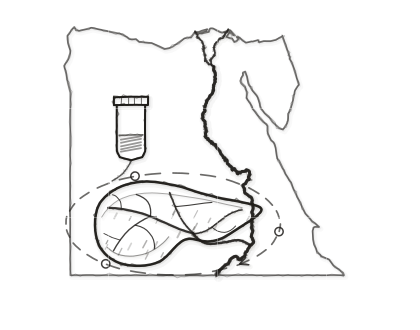
In 2018 the Egyptian Ministry of Health, the National Committee for Control of Viral Hepatitis (NCCVH), and the World Bank launched 100 Million Seha. Within roughly eighteen months the campaign screened more than sixty million people for hepatitis C and put over 4.1 million on directly-acting antivirals. By 2022 the new-infection rate had fallen from approximately 300 per 100,000 in 2014 to 9 per 100,000. The WHO has called Egypt's program the most successful disease-elimination push of the past decade. It is, by almost any measure, the most consequential thing the Egyptian health system has done in my lifetime.
I am a third-year MBBS student. I am Egyptian; I train abroad; I begin internship at Kasr Al-Aini, Cairo University, in 2028. The program that cured four million Egyptians of hepatitis C ended before I touched a stethoscope. The patients it cured will be the patients I see for the rest of my career.
This essay is about the problem the cure left behind, why it is technically hard, and how I would start.
The denominator nobody planned for
Sustained virological response after DAA therapy reduces but does not eliminate the risk of hepatocellular carcinoma (HCC). For patients who entered treatment with advanced fibrosis (F3) or cirrhosis (F4) — a large fraction of the Egyptian treated cohort, given how late most cases were diagnosed — residual annual HCC incidence sits between roughly 1% and 3%, and persists for at least a decade after cure. Multiplied across a treated population of 4.1 million with a substantial advanced-fibrosis fraction, the projected post-SVR HCC burden over the next two decades is plausibly the largest single-population HCC surveillance problem in the world.
The current standard of care is ultrasound plus serum alpha-fetoprotein every six months. The pooled sensitivity of ultrasound for early-stage HCC is approximately 47% in the most recent meta-analyses; adding AFP raises it to roughly 60%. We are using a test that misses two early HCCs in every five and asking it to carry a four-million-patient program. The shortfall is not because anyone is incompetent. It is because Egypt is running a 1980s screening pathway on a 21st-century disease-elimination project.
Compounding this: the aetiology of Egyptian HCC is shifting. A recent review from the Egyptian Network for the Study of HCC describes the post-elimination transition explicitly — as the HCV-driven HCC tail recedes, metabolic dysfunction-associated steatotic liver disease (MASLD) is rising as the dominant new aetiology, driven by the nutrition transition the country is undergoing. The surveillance pathway has to carry two biologically distinct populations at once: cured-viral and metabolic. Today it carries neither well.
Where the bottleneck actually is
The bottleneck here is technical, not financial. Egypt has demonstrated, with 100 Million Seha, that it can move sixty million people through a coordinated screening program when it decides to. The Ministry of Health has the budget. The NCCVH has the registry. The Egyptian Network for the Study of HCC has the multi-site clinical infrastructure. What does not exist — anywhere in the world — is a validated, locally calibrated, cost-engineered HCC surveillance pathway suited to a four-million-patient post-elimination cohort.
The R&D required to build it sits across five concrete problems.
-
Multi-marker score validation in this specific population. The best-developed biomarker integration scores — GALAD (gender, age, AFP-L3, AFP, des-gamma-carboxy-prothrombin), HES V2.0, GAAD, ASAP — outperform ultrasound plus AFP in phase 3 biomarker studies and have meaningfully higher sensitivity for early HCC. None has been validated in a post-SVR Egyptian cohort at meaningful scale. The published validations were derived in European and East Asian cohorts with different fibrosis distributions, different baseline HCC incidence, and different post-DAA biomarker kinetics. Validation is not a paperwork exercise. It is the re-derivation of thresholds against a population whose liver biology was shaped by decades of HCV and is now regressing in ways that are still being characterised.
-
The post-SVR biology is different, and existing liquid-biopsy assays may not transfer. HCV-induced epigenetic alterations persist after viral clearance. Aberrant methylation of APC, P14, E-cadherin, and CDKN2A has been documented in Egyptian HCV-related HCC tumours. Commercial methylation-based blood assays (HelioLiver-class, mSEPT9-based panels) were trained largely on viremic or treatment-naive patients. The ctDNA fragmentation and methylation signal in a regressing-fibrosis liver three years post-SVR is not the same signal. Whether existing panels transfer is an open empirical question that no group is positioned to answer except researchers with sustained access to the post-SVR Egyptian cohort.
-
The biology is also bifurcating. A surveillance assay tuned to post-HCV biology may underperform on the incoming MASLD-HCC cohort, and the reverse. Building a single pathway that risk-stratifies and triages both subtypes is a multi-modal modelling problem: integrating serum biomarkers, FIB-4 and liver stiffness measurement where available, plus aetiology metadata, into a calibrated risk output. This work has not been done because nobody has the cohort and the technical bench to do it together.
-
Cost engineering. Current methylation NGS panels run roughly $400–$800 per test in their commercial markets. To deploy any blood-based assay across a denominator of four million people on a six- to twelve-month cycle, the unit cost has to drop by an order of magnitude. This is not aspirational — it is an engineering specification. The candidate paths are real: targeted methylation by digital PCR on a small panel of high-information loci, multiplexed AFP-L3 and DCP measurement without specialised lectin columns, platform-agnostic chemistries that run on instruments Egyptian governorate labs already own. Each of those is an open development problem with no current answer.
-
Clinical decision integration. Multi-marker scores produce continuous risk outputs. The actionable cutoffs — who is escalated to contrast MRI, who continues serum follow-up, who exits surveillance — depend on the baseline HCC incidence of the surveilled population. The cutoffs from a Mayo Clinic cohort cannot be the cutoffs for the Kasr Al-Aini HCC clinic. Recalibration to local baseline incidence, sequential testing logic, and integration into the existing NCCVH follow-up registry is its own statistical problem and its own software problem.
Why the obvious moves do not work
The shape of the answer is not "import an American assay." Imported assays cost too much, were validated in different biology, and arrive without the recalibration that makes them usable in this population. Nor is the answer "scale up ultrasound." A screening test with 47% sensitivity for early disease cannot be the foundation of a national surveillance pathway; scaling it does not improve its discriminatory power. Nor is the answer a federated genomic biobank in the abstract, because the operational question here is not "what variants?" It is "what blood test, on what cadence, with what action threshold, for which subset of which patients?" That is a different question and it has a different answer.
The honest version is that no country has had to solve this problem before, because no country has cured four million people. Egypt does not get to import this pathway. It has to build it, and the people who can build it are the ones with sustained access to the cohort.
How a small team starts
The clinical anchor is the multidisciplinary HCC clinic at Kasr Al-Aini, Cairo University — one of the few centres with a continuous post-SVR follow-up registry, sitting inside the Endemic Medicine and Hepato-Gastroenterology Department that was part of the NCCVH from the beginning. The complementary anchor is the National Liver Institute at Menoufia, the country's flagship hepatology research institute, which hosts the largest existing serum biobanks. The Egyptian Network for the Study of HCC is the multi-site federation already in place. None of this needs to be built from scratch. The connective tissue exists.
A workable v0:
Months 0–9, retrospective. Assemble existing biobanked sera and linked clinical metadata for the post-SVR cirrhotic cohort already followed at Kasr Al-Aini's HCC clinic — target n ≈ 500. Apply GALAD, HES V2.0, and GAAD scores on archived sera against the gold-standard imaging follow-up that has accumulated since 2019. First deliverable: locally-derived AUC, sensitivity, and specificity for each score in this specific population, and recalibrated cutoffs. Code and thresholds released openly from day zero.
Months 9–24, prospective. Enrol approximately 300 new post-SVR F3/F4 patients with paired biobanking at enrolment, plus a contemporaneous MASLD-fibrosis subgroup for comparative biology. Six-month surveillance with ultrasound, AFP, and banked serum aliquots. At a subset, pilot a targeted methylation digital PCR panel of five to seven loci selected from the existing Egyptian HCV-HCC epigenetics literature, to evaluate signal in this specific biology.
Months 24–36, federation. Multi-site validation through ENSH: National Liver Institute, Mansoura, Assiut. Cost-engineer the assay toward a unit-cost target of roughly $30. Recalibrate the multi-marker score at population scale. Hand the recalibrated pathway to NCCVH for pilot deployment in one governorate.
The team is small. A clinical principal investigator at Kasr Al-Aini's HCC clinic (the senior staff exists). A molecular diagnostics collaborator at NLI Menoufia or an equivalent international group. A bioinformatician for the score calibration work. A surveillance protocol coordinator. And the clinical-embedded intern — me — for protocol design, prospective case recruitment in the post-SVR clinic, clinical metadata curation, and inter-site coordination. The role I can credibly hold is the one academic medicine has been delegating to junior trainees for a century: the one with the time and the ward access. Everything I do at the clinical end either accelerates the senior collaborators' work or is wasted; the test is whether I show up with a real protocol and real patients, not with ideas.
What it means if it works
A locally-derived, blood-based HCC surveillance score calibrated to the post-SVR Egyptian cohort, deployable at roughly $30 per test, with action thresholds tuned to actual baseline incidence in this population. A pathway that pivots as the underlying aetiology shifts from cured-viral to metabolic. A surveillance infrastructure that the next country to do what Egypt did — Pakistan, Mongolia, Rwanda — does not have to build from scratch.
The cure was the part the world watched. The surveillance is the part it will not, and it is the part that decides whether four million cures hold.