Lebanon is a country where the land remembers. Its mountains carry the silence of old villages, its coast holds the movement of generations, and its fields preserve the work of families who have planted, harvested, and rebuilt through decades of instability. Here, land is not simply property. It is history, livelihood, memory, and proof of belonging.
In the South, this relationship becomes even more intimate and deeply rooted in the diversity of its land. Tobacco fields stretch alongside orchards of olive trees that have stood for centuries, their branches carrying both fruit and heritage. Citrus and orange grooves, fill the air with scent, while fig trees, pomegranate trees, and grapevines mark the rhythm of the seasons. Almond blossoms signal the arrival of spring, and carob trees, resilient and enduring, anchor the landscape through drought and hardship. Stone terraces hold these ecosystems together, preserving soil and water while shaping the hills into living archives of cultivation. These lands feed families, sustain local economies, and embody generational knowledge passed through hands and harvests. Yet war does not only destroy what can be seen. It enters the soil, the water, and the ecosystems that communities depend on long after the smoke has disappeared.
White phosphorus is a highly reactive and toxic form of phosphorus used in military munitions to generate smoke screens and incendiary effects (Karnib & Faraj, 2024). When exposed to oxygen, it ignites spontaneously and burns at temperatures exceeding 800°C, producing heat, white smoke, and toxic combustion products capable of causing deep burns, respiratory injury, and organ failure (AUB-FAFS, 2024; Karnib & Faraj, 2024). When such munitions detonate in the air, burning fragments can descend across residential areas, forests, and agricultural fields, igniting vegetation and exposing humans, animals, and ecosystems to toxic smoke (Griffiths & Joronen, 2026). But wounds are not always the ones that burn visibly. White phosphorus may disappear from the sky while its consequences remain beneath the surface, in altered soil chemistry, damaged crops, contaminated water pathways, and the uncertainty of farmers who no longer know whether planting is an act of hope or exposure (AUB-FAFS, 2024; Karnib & Faraj, 2024).
But the South has never been defined only by what was done to it. It has always been defined by wha t it rebuilds. This project begins from an urgent belief: recovery must reach deeper than reconstruction. Through soil monitoring, microbial biotechnology, phytoremediation, and locally adapted farming practices, it seeks to restore ecological function and ensure that war does not continue beneath the ground after the weapons fall silent. The central problem is not simply that Lebanon lacks a technology capable of “cleaning white phosphorus.” It is that no validated system currently determines what remains in a field after a white-phosphorus strike, how that profile changes with time and depth, which intervention the land actually requires, and when it is safe to cultivate again. Without this information, remediation risks becoming either dangerously insufficient or unnecessarily expensive.
Research in Lebanon has already shown why a single remediation method cannot be applied blindly across the South. Karnib and Faraj detected white phosphorus in soil from seven villages, including particles at a depth of 30 cm where corresponding 5 cm samples were negative (Karnib & Faraj, 2024). Yet a later campaign found no systematic increase in total phosphorus or soil acidity at documented strike sites, while Houla, where white phosphorus use had been confirmed, emerged as a hotspot for lead, antimony, copper, and zinc (Amel Association et al., 2026). Soon after a strike, intact particles and elevated phosphorus may be detectable, but oxidation, weathering, and leaching can gradually weaken that signal. What remains may be deeper particles, mobile phosphorus compounds, toxic metals, disrupted microbial activity, and soil that has lost the biological functions necessary for cultivation (Karnib & Faraj, 2024; Amel Association et al., 2026).
Total phosphorus cannot reveal whether elemental white phosphorus is still present, and a clean surface sample cannot guarantee that contamination is absent below it (Karnib & Faraj, 2024; Amel Association et al., 2026). A treatment chosen only according to the weapon used, rather than the contamination that remains, could therefore waste scarce resources or return unsafe land to farmers. Lebanon needs a method that distinguishes recent white-phosphorus hotspots from older metal-contaminated soils, biologically degraded land, and lower-risk fields that may require monitoring rather than intervention.
Existing remediation technologies solve only fragments of this problem. At Eagle River Flats in Alaska, dredging, drainage, and enhanced natural attenuation were tested in a flooded salt marsh. Pumping showed promise because drying exposed buried phosphorus to oxygen, but the method depended on wetland conditions that cannot simply be reproduced in Lebanese orchards and stone terraces (Walsh et al., 1999). A German patented process used copper compounds and hydrogen peroxide to oxidize elemental phosphorus in excavated soil or sludge, but it required controlled chemical treatment and waste management, making it more suitable for isolated hotspots than extensive agricultural landscapes (Bergmann et al., 1999). Laboratory studies also found that Streptomyces sp. A8 and Trichoderma asperellum F-1087 could tolerate white phosphorus, but tolerance does not yet demonstrate complete degradation, harmless transformation products, or field effectiveness (Mindubaev et al., 2018). Broader post-war restoration models combine soil repair, biological recovery, and phytoremediation, yet they do not explain how treatment should change as the contamination profile evolves (Chaika et al., 2026). Lebanese policy work has therefore called for localized research and continued testing of soil, water, and agricultural products instead of importing methods without adaptation (Kallab & Mouawad, 2023).
BIORESTORE is designed to close this gap. It is not a plan to spread microbes, biochar, and plants across every affected field. It is a time- and depth-sensitive soil triage system paired with one focused biological recovery experiment. Its purpose is to determine what remains, direct each site toward the appropriate response, and generate evidence for when cultivation can safely resume.
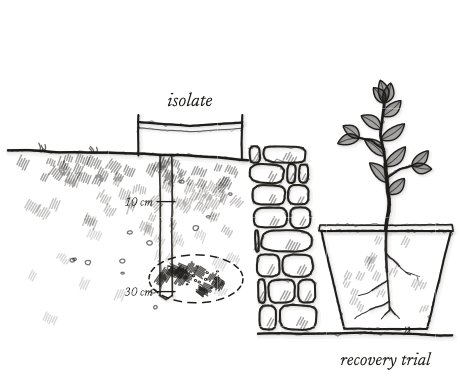
The project would begin as a twelve-month pilot at four previously cleared agricultural sites representing different strike histories, soil conditions, land uses, and periods since exposure. Each site would be compared with a nearby unaffected field. Sampling would follow a grid while adding targeted samples around impact points, burned zones, or areas previously reported as positive. Soil would be collected from 0–10 cm and 10–30 cm because military contamination can be extremely localized and may remain buried beyond the depth examined by ordinary topsoil surveys (Karnib & Faraj, 2024; Amel Association et al., 2026).
The first module, BIORESTORE-Triage, would use affordable tests first and advanced analyses only where they are justified. Every sample would be assessed for pH, electrical conductivity, moisture, organic carbon, available phosphorus, selected metals, microbial respiration, and phosphatase and dehydrogenase activity. Together, these measurements would show whether the soil is chemically disturbed, biologically inactive, or still capable of natural recovery. Sites with recent strikes, previous positive results, or suspicious deeper samples would undergo direct elemental white-phosphorus analysis and phosphorus speciation (Karnib & Faraj, 2024; Amel Association et al., 2026). Microbial community sequencing would be reserved for representative samples with clear biological disruption, while metagenomic analysis would be used only when simpler tests cannot explain the missing functions. This tiered structure preserves biotechnology where it adds information without making expensive sequencing a condition for every field.
The results would feed into a four-branch decision tree. Confirmed elemental-white-phosphorus hotspots would be isolated and referred to trained hazardous-material teams for controlled excavation, oxidation, containment, or monitored attenuation (Walsh et al., 1999; Bergmann et al., 1999). Areas dominated by persistent metals would move toward stabilization and non-food vegetation selected to reduce erosion without transferring contaminants into the food chain. Soils with no immediate chemical hazard but low microbial activity and poor plant establishment would enter the biological recovery trial. Lower-risk fields would remain under monitoring and receive staged guidance for agricultural return. The output would therefore be more than another contamination map: it would be a reproducible rule explaining what each category of land requires next.
The second module, BIORESTORE-Recover, would test whether locally sourced microorganisms delivered through standardized olive-pruning biochar can restore biological function in soils that are no longer chemically dangerous. Clean olive-pruning residues would be converted into biochar under controlled conditions and tested for pH, ash content, stability, and contaminants before application. Biochar would not be described as a material that destroys elemental white phosphorus. Its role would be to provide porous shelter for microorganisms, improve moisture retention, support soil carbon, and potentially reduce the mobility of selected metals while the soil microbiome recovers (Chaika et al., 2026). Eligible soil from each site would enter a controlled microcosm experiment with four treatment groups: untreated soil, biochar alone, a locally derived microbial inoculum alone, and biochar carrying the inoculum. Rather than importing a large generic consortium, the microbial inoculum would be selected from healthy Lebanese soils and screened for safety, survival, plant-growth support, and compatibility with the affected soil. White-phosphorus-tolerant organisms identified by Mindubaev et al. in 2018 would be examined separately until their degradation products and field safety are understood. The central trial would therefore remain grounded in established soil-recovery functions instead of depending on an unproven claim of white-phosphorus biodegradation.
A native, drought-tolerant, non-food pioneer plant would act as a biological indicator of recovery. The primary outcomes would be microbial respiration and plant biomass after three and six months, supported by enzyme activity, soil organic carbon, water retention, and bioavailable-metal measurements. The combined biochar–microbe treatment would advance to a small contained field plot only if it improves biological function beyond either component alone without mobilizing contaminants or increasing their accumulation in plant tissue. These explicit go-or-no-go criteria make BIORESTORE falsifiable: the treatment progresses because evidence supports it, not because the concept is emotionally compelling.
A core team consisting of an environmental chemist, a soil microbiologist, an agronomist, and a local field coordinator could begin through partnerships with an accredited laboratory, a demining organization, and one agricultural cooperative. During the first three months, the team would select cleared sites, establish controls, complete baseline sampling, and standardize the olive-residue biochar. Months four to eight would run the microcosm experiment and build the diagnostic decision tree. Months nine to twelve would repeat seasonal measurements and, only if safety and effectiveness thresholds are met, establish a contained pilot plot.
The project would produce three concrete outcomes: a depth- and time-sensitive sampling protocol, a decision tree directing affected farmland toward the correct treatment, and experimental evidence showing whether locally sourced microbes carried in olive-residue biochar restore soil function better than either component alone. Just as importantly, it would identify where biotechnology is inappropriate and specialist chemical management is necessary. A credible restoration system must know not only what it can treat, but where it must stop.
The main limitation remains the uneven distribution of contamination. A missed particle may create false reassurance, while total phosphorus alone cannot prove the presence or absence of elemental white phosphorus (Karnib & Faraj, 2024; Amel Association et al., 2026). Microbial treatments may also behave differently across Lebanon’s calcareous soils, and biochar properties will vary with feedstock and production conditions. BIORESTORE responds through repeated depth sampling, matched controls, batch testing, contained experiments, and decision gates that expose uncertainty instead of hiding it behind the language of innovation.
If the pilot succeeds, expansion would not mean applying one formula across the South. It would mean building a Lebanese evidence library linking strike history, time, depth, soil chemistry, microbial function, and treatment response. Over time, this could support safer return-to-farming decisions, locally adapted microbial resources, standardized agricultural-waste biochar, and a framework transferable to other war-affected landscapes in the MENA region. Recovery would no longer be declared when the smoke disappears or when one surface sample appears clean. It would be demonstrated when the soil breathes again, plants grow without carrying war into the food chain, and farmers return to their fields with evidence rather than uncertainty.
References
- Amel Italia, Amel Association International, & Source International. (2026, May). Legacy of conflict in South Lebanon’s soils: Technical report from the Turabna–Janoub Soil Monitoring pilot, August 2025 campaign. https://amel.org/wp-content/uploads/2026/05/Legacy-of-conflict-in-South-Lebanons-soils-2026.pdf123456
- American University of Beirut, Faculty of Agricultural and Food Sciences. (2024, November 7). White phosphorus and the future of southern Lebanon’s agricultural heartland: An emerging crisis. https://www.aub.edu.lb/fafs/news/Pages/2024_White-Phosphorus-and-the-Future-of-Southern-Lebanon-Agricultural-Heartland.aspx12
- Bergmann, V., Dueresch, R., & Ladde, G. (1999). Verfahren zur Herabsetzung des Gehaltes von weißem elementaren Phosphor in Stoffgemischen mittels Oxidation [Method for reducing the content of white elemental phosphorus in mixtures through oxidation] (German Patent No. DE19747793C1). German Patent and Trade Mark Office. https://patents.google.com/patent/DE19747793C1/en.12
- Chaika, T., Shevnikov, M., Stetsenko, A., & Liashenko, V. (2026). Conceptual model of post-war restoration of agricultural land with integration of bioenergy technologies. Scientific Reports of the National University of Life and Environmental Sciences of Ukraine, 22(2), 65–89. https://doi.org/10.31548/dopovidi/2.2026.6512
- Griffiths, M., & Joronen, M. (2026). The military violence of white phosphorus: Geopower, weathering, inhabitability. Annals of the American Association of Geographers. Advance online publication. https://doi.org/10.1080/24694452.2026.2673231↩
- Kallab, A., & Mouawad, L. R. (2023, November). The socio-environmental impact of white phosphorous ammunition in South Lebanon: Analysis and risk mitigation strategies. Nature Conservation Center, American University of Beirut. https://hdl.handle.net/10938/24618↩
- Karnib, M. Y., & Faraj, M. K. (2024). A qualitative method for white phosphorus detection in South Lebanon soils. Journal of Physics: Conference Series, 2857(1), Article 012035. https://doi.org/10.1088/1742-6596/2857/1/012035123456789
- Mindubaev, A. Z., Voloshina, A. D., Kulik, N. V., Validov, Sh. Z., Saparmyradov, A., Minzanova, S. T., Mironova, L. G., & Yakhvarov, D. G. (2018). Effect of selection upon resistance of microorganisms to white phosphorus. Chemical Safety Science, 2(1), 191–205. https://doi.org/10.25514/CHS.2018.1.12893↩
- Walsh, M. R., Walsh, M. E., & Collins, C. M. (2002). Remediation methods for white phosphorus contamination in a coastal salt marsh. Environmental Conservation, 26(2), 112–124. https://doi.org/10.1017/S037689299900016812